Winmau Masters Pro Dartboard Review: Worth It? We Ran the Numbers
You're spending £6 a session playing pub darts twice a week. The Winmau Masters Pro is £64.99. We ran the actual numbers to find out which works out cheaper — and by how much.
You go to the pub twice a week to play darts. Call it £6 in drinks per visit, minimum — usually closer to £10 by the time you've had a second round and someone bought a round back. That's £48–80 a month on evenings that are, at their core, about throwing things at a wall.
The Winmau Masters Pro is £64.99. It arrives in a box. You put it on a wall. You play whenever you want.
The maths was always going to work. The question is whether this specific board, at this specific price, is actually the right one to buy — or whether you're paying a premium for a name.
Check current price on Amazon UK → (affiliate link)

What You Actually Get
The Winmau Masters Pro is a full-size sisal dartboard with a few specific features that separate it from budget options.
Ultra-thin wire system. The spider — the wire grid that separates the segments — is the main cause of bounce-outs. Thicker wire means more darts hit metal instead of sisal and bounce back. Winmau's ultra-thin wire is the same specification used in PDC televised tournaments. In practice this means fewer infuriating bounce-outs, especially around the doubles and trebles ring where tournament pressure is highest.
High-density sisal. Sisal is the compressed plant fibre that makes up the board surface. Higher density means the fibres close around dart entry points rather than staying open — so the board self-heals between sessions and lasts longer. Low-density boards start showing permanent holes within months of regular play.
PDC tournament specification. Winmau has supplied the PDC since the organisation's founding. The Masters Pro shares dimensional spec with boards used in major televised events. Whether that matters to you depends on whether you care about training on tournament-equivalent equipment — if you're playing competitively at local league level, it probably does.
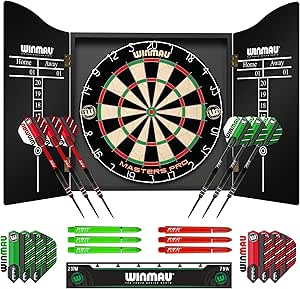
What you don't get: a surround (the foam ring that catches missed darts and protects your wall), a proper dartboard cabinet, or steel tip darts. If you're mounting this from scratch, budget another £15–25 for a surround and a set of darts. The total setup still comes in well under £100.
The Numbers: Pub Darts vs. Home Darts
The break-even calculation here is simpler than most. You're replacing a recurring cost — pub visits — with a one-time cost.
Run it through the Subscription Cost Calculator: treat your pub darts sessions as a monthly subscription. Two sessions a week at £8 average spend: £64 a month. One session a week at £6: £24 a month.
| Frequency | Monthly pub cost | Break-even on £64.99 board |
|---|---|---|
| Twice a week, £8/session | £64 | Under 2 months |
| Once a week, £6/session | £24 | ~2.7 months |
| Once a week, £4/session | £16 | ~4 months |
Even at the most conservative estimate — one session a week, just one drink — the board pays for itself in four months. After that every session is effectively free.
Year one, playing twice a week: you save approximately £700. Year two onwards: £768 a year. That's not including the travel, the parking, or the time spent getting ready to leave the house.
The comparison isn't quite one-to-one — the pub gives you a social setting, a bar, other people to play against. But if you're playing with the same group of friends anyway, you can do that at someone's house just as easily, and for considerably less money per evening.
What the 565 Reviews Actually Say
At 4.5 stars across 565 reviews, the pattern in the feedback is consistent enough to be informative.
The positives cluster around two things: board quality and wire quality. Multiple reviewers who upgraded from cheaper boards note the reduction in bounce-outs immediately. Several mention the board surface holding up well after six months to a year of regular play — which is where budget boards typically start degrading.
The negatives are less about the board itself and more about setup expectations. A handful of one-star reviews are from people who expected darts to be included, or didn't realise they needed a surround for wall protection. These are realistic expectations issues rather than product defects.
One recurring positive worth noting: the segmentation is clean and accurate, which matters for competitive play. Budget boards occasionally have segments that are slightly off-spec or inconsistently sized, which trains bad habits if you're working on your game seriously.
What to Check Before You Commit
Your wall situation. Dartboards need to be mounted at 5ft 8in (1.73m) to the bull's-eye, with a throw line at 7ft 9.25in (2.37m) on carpet. Measure this before you commit. Some rental properties have restrictions on drilling — a freestanding dartboard stand (around £40) solves this but adds to the total cost.
Noise. Steel tip darts on a sisal board are not silent. The thud of a dart landing plus the occasional bounce-out hitting the floor is audible, especially in flats with neighbours below or adjacent. If noise is a real concern, soft tip darts on an electronic board are a different product category entirely.
Whether you'll actually play. This sounds obvious but it matters. If you play darts enthusiastically at the pub largely because the setup is already there and the atmosphere pushes you into it, that motivation doesn't automatically transfer to home. If you have a dedicated space and people who'll actually use it, the savings are substantial. If the board ends up gathering dust in a cupboard after two months, it's a worse investment than the pub rounds it was supposed to replace.
Worth It?
For anyone playing darts more than once a week with a consistent group: yes, unambiguously. The board is tournament-specified, the ultra-thin wire is a real functional improvement over budget alternatives, and the payback period is measured in months rather than years.
For occasional players — once a month or less — a £25–30 board is sufficient. The premium sisal and thin wire only justify their cost under regular, sustained use.
At £64.99, the Masters Pro sits at the right price point: meaningfully better than the budget tier, not indulgently priced like Winmau's top-end Blade 6. It's the board for people who are serious about playing at home without being serious about spending on gear.
Check current price on Amazon UK → (affiliate link)
This article contains an affiliate link. If you buy through it, we earn a small commission at no extra cost to you. We only link to products we'd actually recommend.
Numbers: pub spend estimates based on UK average pub drink prices (ONS 2024). Break-even figures calculated using the Subscription Cost Calculator with monthly recurring cost inputs.